
December 9, 2025

Screen Time: Finding Digital Balance
In today’s world, digital devices are a big part of everyday life—for learning, creating, staying connected, and having fun. But just like eating a balanced diet keeps our bodies healthy, finding the right balance of screen time helps keep our minds and digital habits healthy too.
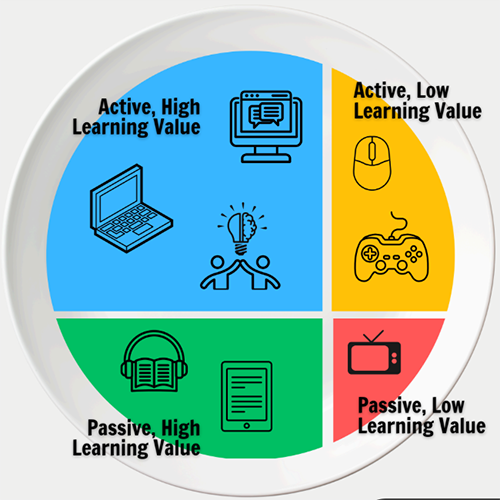
Inspired by Richard Culatta’s Digital for Good (2021), the Digital Plate offers an easy way for families and educators to visualize what balanced tech use looks like. Modeled after the MyPlate food guide, it breaks digital activities into four categories based on whether they are active or passive and high or low learning value.
Understanding the Digital Plate
Active, High Learning Value
These are the “superfoods” of screen time. They involve thinking, creating, collaborating, and engaging in activities that support learning goals. Examples include coding, designing presentations, interactive learning platforms, and tools that adapt to a student’s needs.
Passive, High Learning Value
These activities help students absorb information tied to learning objectives—like reading online articles, watching educational videos, or using digital textbooks.
Active, Low Learning Value
These activities are fun and engaging but not necessarily tied to academic standards. Think of them as digital “treats”—fine in moderation.
Passive, Low Learning Value
This includes scrolling, watching random videos, or browsing content that doesn’t support learning goals. These are the “desserts” of the digital diet and should be limited.
What the Research Says
Studies show that how students use their devices matters more than how much time they spend on them. In classrooms, most screen time is spent in the active, high-learning quadrant—using technology as a tool for hands-on, meaningful instruction. The goal is not to limit all digital use, but to guide students toward purposeful, balanced engagement.
Critical Actions for Families
Talk with your children about what balanced digital use looks like.
Create a Family Media Use Agreement tailored to each child.
Monitor digital activity and ensure it doesn’t disrupt healthy routines like sleep.
Help kids reflect on whether their activities are productive, passive, creative, or merely entertaining.
Critical Actions for Educators
Clearly share and explain the digital tools used in class.
Integrate digital citizenship into daily instruction.
Partner with families to build healthy digital habits at school and at home.
By understanding the types of digital activities—not just the amount of screen time—students can learn to self-regulate, make healthier choices, and thrive in both the digital and physical world.
In today’s world, digital devices are a big part of everyday life—for learning, creating, staying connected, and having fun. But just like eating a balanced diet keeps our bodies healthy, finding the right balance of screen time helps keep our minds and digital habits healthy too.
Inspired by Richard Culatta’s Digital for Good (2021), the Digital Plate offers an easy way for families and educators to visualize what balanced tech use looks like. Modeled after the MyPlate food guide, it breaks digital activities into four categories based on whether they are active or passive and high or low learning value.
Understanding the Digital Plate
Active, High Learning Value
These are the “superfoods” of screen time. They involve thinking, creating, collaborating, and engaging in activities that support learning goals. Examples include coding, designing presentations, interactive learning platforms, and tools that adapt to a student’s needs.
Passive, High Learning Value
These activities help students absorb information tied to learning objectives—like reading online articles, watching educational videos, or using digital textbooks.
Active, Low Learning Value
These activities are fun and engaging but not necessarily tied to academic standards. Think of them as digital “treats”—fine in moderation.
Passive, Low Learning Value
This includes scrolling, watching random videos, or browsing content that doesn’t support learning goals. These are the “desserts” of the digital diet and should be limited.
What the Research Says
Studies show that how students use their devices matters more than how much time they spend on them. In classrooms, most screen time is spent in the active, high-learning quadrant—using technology as a tool for hands-on, meaningful instruction. The goal is not to limit all digital use, but to guide students toward purposeful, balanced engagement.
Critical Actions for Families
Talk with your children about what balanced digital use looks like.
Create a Family Media Use Agreement tailored to each child.
Monitor digital activity and ensure it doesn’t disrupt healthy routines like sleep.
Help kids reflect on whether their activities are productive, passive, creative, or merely entertaining.
Critical Actions for Educators
Clearly share and explain the digital tools used in class.
Integrate digital citizenship into daily instruction.
Partner with families to build healthy digital habits at school and at home.
By understanding the types of digital activities—not just the amount of screen time—students can learn to self-regulate, make healthier choices, and thrive in both the digital and physical world.